
Who we Are
Protexis Command and Control Services LLC is a satellite and cellular IoT monitoring company headquartered in Louisiana. We design, build, install, and operate remote asset monitoring systems for industries that work in hard-to-reach and harsh environments — including oil and gas production, dam and reservoir management, water and wastewater infrastructure, agriculture, and government-managed public lands.
The company was founded by experienced field service professionals, whose background spans industrial controls and automation, PLC programming, hardware design, and embedded systems development. That hands-on engineering foundation is what sets Protexis apart: we do not resell off-the-shelf monitoring packages. We design custom monitoring hardware in-house, configure application-specific builds from our PMU product line, and deploy complete systems — from sensor to satellite to alert notification — as a single integrated service.
Protexis currently operates in 13 states with an expanding footprint supporting state and federal agency dam safety programs in multiple regions of the United States. Our monitoring platform supports dual-mode ORBCOMM satellite and cellular connectivity, machine-to-machine automation, multi-level alert escalation, and 24/7 call center response — delivering reliable oversight for critical assets that cannot afford gaps in visibility.
We work with private operators, state departments of conservation, federal land management agencies, and local soil and water conservation districts. Whether the requirement is a single wellhead monitor on a remote lease or a multi-site early warning system across a federal forest, Protexis provides the same level of engineering rigor and operational accountability.
As you can see, Protexis has provided solutions for all types of applications. Protexis has answered the call for minor construction applications, and we have been there to untangle even the biggest of messes.
How Satellite IoT Monitoring Systems Strengthen Dam Safety and Early Warning Programs
Dams and reservoirs in remote locations present a persistent monitoring challenge. Many of these structures sit miles from paved roads, far from grid power, and outside the reach of cellular networks. Traditional monitoring approaches — manual gauge readings, periodic inspections, and phone-based reporting chains — leave gaps that regulators and dam owners increasingly cannot afford.
Satellite-based IoT monitoring closes those gaps by delivering continuous, automated data from sites that have no existing communications infrastructure. A properly configured remote monitoring system measures water levels with submersible pressure sensors, tracks environmental conditions, and transmits that data over satellite links at scheduled intervals — with event-driven alerts when conditions exceed predefined thresholds.
What a modern dam monitoring system does:
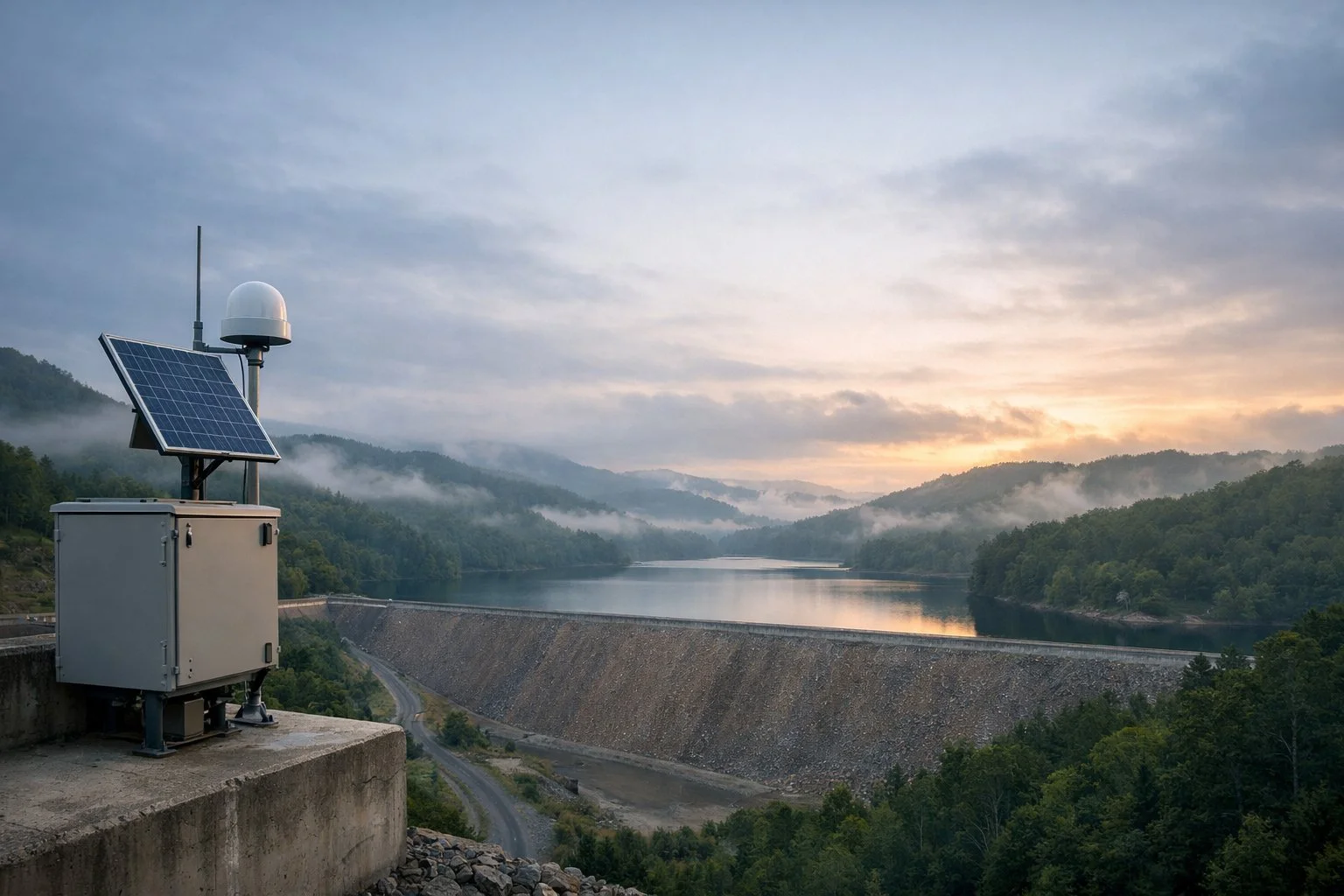
At the core of a satellite dam monitoring deployment is a ruggedized field unit that integrates sensors, a satellite modem, solar power, and onboard computing into a single weatherproof installation. These units operate autonomously in temperature extremes from -40°C to +85°C, powered by solar panels and battery systems that keep them running through extended periods of cloud cover or winter conditions.
The monitoring unit collects data from submersible pressure transducers installed in the reservoir pool and tailwater areas, providing continuous water level measurements. That data is transmitted via satellite at regular intervals — and immediately when levels cross alert thresholds tied to the dam's emergency action plan.
Emergency action plan automation
For regulated dams, the monitoring system maps directly to the structure's emergency action plan (EAP). Multi-level alert thresholds — watch, warning, and emergency — trigger automated notification chains that reach dam owners, responsible agencies, downstream communities, and emergency coordinators. This replaces manual phone trees with reliable automated escalation that works at any hour, in any weather, without depending on someone being available to make calls.
Why satellite connectivity matters for dam monitoring
Cellular-dependent monitoring systems fail at the sites that need monitoring the most. Remote dams on federal forest land, in mountain terrain, or in rural agricultural areas often have no cellular coverage at all. Satellite communication provides global reach with no infrastructure requirements — no towers, no line of sight, no service area limitations. Dual-mode systems that combine satellite and cellular provide redundancy: satellite ensures the data always gets through, while cellular offers higher bandwidth where coverage exists.
Who needs remote dam monitoring
State dam safety programs, federal land management agencies, local soil and water conservation districts, and private dam owners all face increasing regulatory and liability pressure to maintain continuous monitoring on regulated structures. Remote satellite-based monitoring systems provide the documented, timestamped data record that supports compliance reporting, inspection programs, and emergency response coordination.
Organizations evaluating dam monitoring solutions should look for providers that offer full-service capabilities: hardware design, field installation, satellite activation, sensor calibration, and ongoing 24/7 alert monitoring — not just equipment sales.
Satellite and Cellular IoT Monitoring for Remote Oil and Gas Operations
Oil and gas operators manage production assets spread across thousands of acres of leased land — wellheads, compressor stations, tank batteries, pipeline segments, and injection wells that are often hours from the nearest office and far from reliable communications infrastructure. Monitoring these assets has traditionally depended on manual field rounds, local alarm panels, and SCADA systems that require dedicated radio or cellular networks to function.
Satellite and cellular IoT monitoring provides an alternative that eliminates the infrastructure dependency. A dual-mode monitoring unit installed at a remote wellhead or compressor station transmits operational data — pressures, temperatures, tank levels, equipment status, power conditions — over satellite and cellular networks without requiring any local communications infrastructure to be built or maintained.
What remote monitoring covers in oil and gas
A typical production monitoring deployment tracks the parameters that indicate whether equipment is operating within normal ranges and whether intervention is needed. This includes wellhead pressures (casing and tubing), flow line temperatures, separator and tank levels, compressor operating status, chemical injection pump rates, and power system voltages.
The monitoring hardware connects to these data sources through standard industrial interfaces: 4-20mA current loop inputs for analog transmitters, RS-485 MODBUS for digital instruments and PLCs, and digital I/O for status contacts and control relays. A single 10-port monitoring unit can aggregate data from multiple instruments at a well site or production facility, eliminating the need for separate communication paths for each sensor.
Why dual-mode satellite and cellular matters
Many upstream and midstream assets sit in locations where cellular coverage is unreliable or nonexistent — deep in basins, on mountain leases, or in remote areas of West Texas, South Louisiana, or the Rocky Mountain region. Satellite communication provides coverage everywhere on Earth without depending on terrestrial infrastructure. Cellular provides higher data throughput where towers are nearby. Dual-mode systems use both paths, automatically routing data through whichever link is available.
This dual-mode approach means operators get monitoring coverage on day one of a new well completion or facility startup — no waiting for radio towers, no negotiating cellular backhaul agreements, no building out dedicated SCADA communication networks before the first data point flows.
Alerts, automation, and machine-to-machine control
Beyond data collection, satellite IoT monitoring systems support automated alert rules and machine-to-machine (M2M) actions. High-pressure or low-level conditions can trigger immediate alert notifications to field personnel. Equipment failures generate escalating notification chains that ensure the right operations or maintenance team is contacted. M2M rules can trigger automated responses between devices — for example, shutting down a compressor when a downstream pressure reading exceeds safety limits.
These automation capabilities reduce the response time gap that exists when field rounds happen only once or twice per day. Critical conditions are flagged within minutes of occurrence, not hours.
What to look for in a remote monitoring provider
Oil and gas operators evaluating remote monitoring solutions should consider whether the provider offers hardware that is rated for the environmental conditions of production operations — temperature extremes, vibration, corrosive atmospheres, and hazardous area classifications. They should also evaluate whether the provider can handle the full deployment lifecycle: site survey, hardware configuration, field installation, satellite activation, and ongoing monitoring — not just equipment supply.
Providers with experience across multiple terminal platforms and application configurations can match the right hardware to each site's complexity and budget, rather than forcing a one-size-fits-all approach.